

Business Transformation and Independent Talent 2026

BUSINESS TRANSFORMATION & INDEPENDENT TALENT REPORT 2026
Executive Summary
Business transformation has evolved from episodic change to continuous reinvention. At High5 we have developed a global network of independent consulting talent to execute the initiatives that form the dominant transformation archetypes. There is a dramatic shift toward external talent models and particularly the rise of fractional executives and independent consultants leading transformation projects and High5 is one of the leading sources to support the need for transformation, and the talent to deliver.
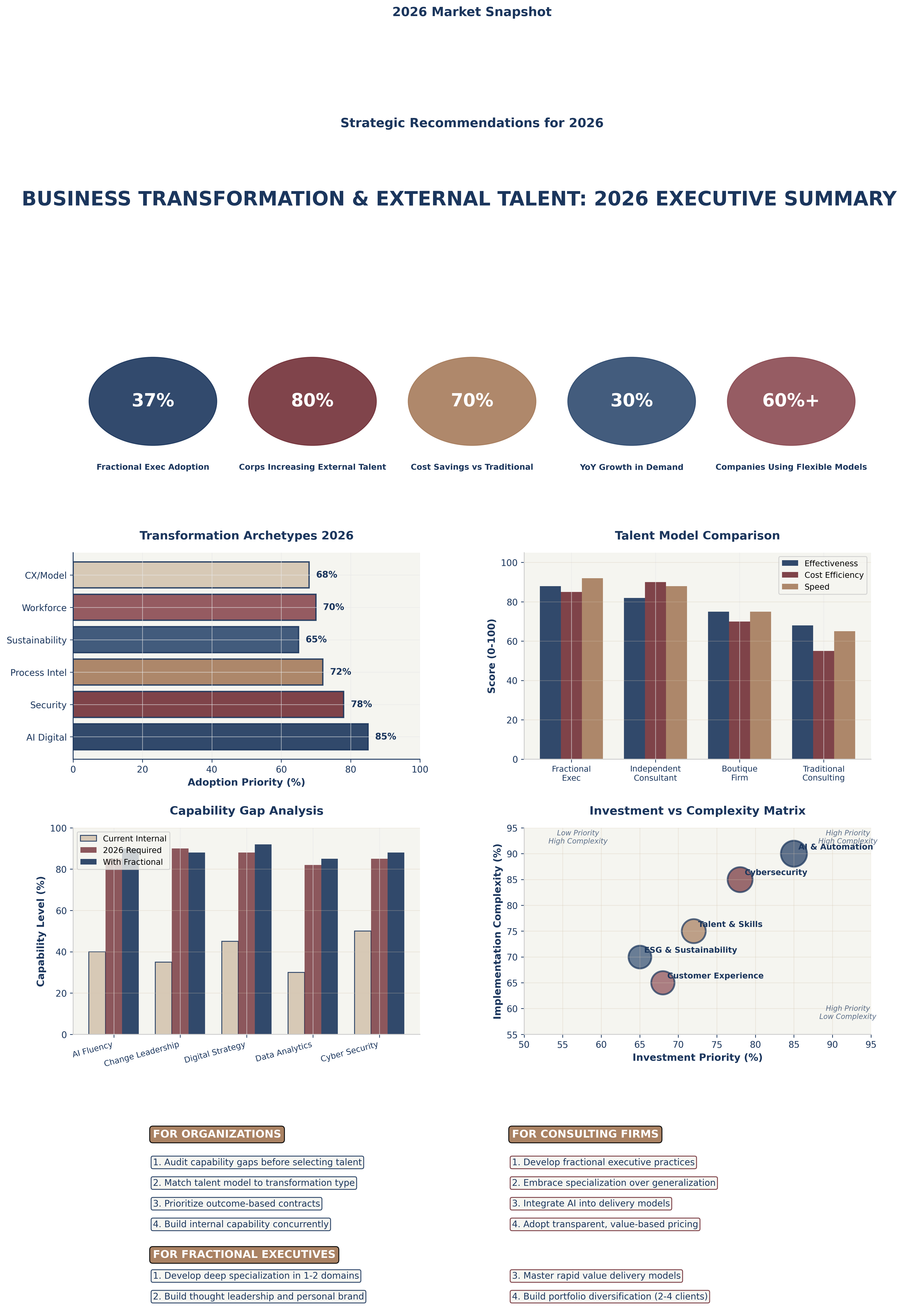
Key Finding: By 2026, over 60% of companies will rely on flexible leadership models to stay competitive, with demand for interim and fractional leaders growing 30% year-over-year. The external talent ecosystem has matured beyond traditional consulting firms to encompass independent specialists, boutique firms, and fractional C-suite executives who combine strategic expertise with execution agility.
1. The Transformation Landscape: Six Archetypes for 2026
1.1 AI-Powered Digital Reinvention
Digital transformation remains firmly at the core of business change, but 2026 marks a shift from experimental AI adoption to serious infrastructure deployment. Organizations are moving beyond pilot phases to scale AI across entire tech stacks, with 75% of businesses now using AI in some capacity.
Key Characteristics:
Agentic AI Integration: AI agents are proliferating rapidly, with 59% of businesses planning investments in agentic AI over the next 12 months
Hyper-automation: Multi-step, intelligent workflows replacing basic automation
Physical-Digital Convergence: AI extending beyond screens into robotics and autonomous systems
1.2 Zero-Trust Security Transformation
Following high-profile breaches, cybersecurity has become a board-level transformation imperative. 85% of UK organizations plan to increase cyber budgets in 2026, with zero-trust architecture becoming standard practice.
1.3 Process Intelligence & Operational Excellence
Organizations are shifting from "what happened?" to "what will happen and what should we do?"—using process intelligence for real-time analytics and predictive monitoring.
1.4 Sustainable Business Model Innovation
ESG considerations are driving fundamental business model reinvention, with 69% of CEOs viewing sustainability as a key growth opportunity.
1.5 Workforce & Organizational Redesign
The "future of work" has arrived, requiring complete reinvention of organizational structures, talent models, and employee value propositions. Skills-based hiring is replacing credential-based recruitment.
1.6 Customer Experience & Business Model Innovation
From "shoppertainment" to subscription ecosystems, organizations are transforming how they create, deliver, and capture value.

2. Talent Requirements: The Capability Gap
2.1 The Leadership Crisis
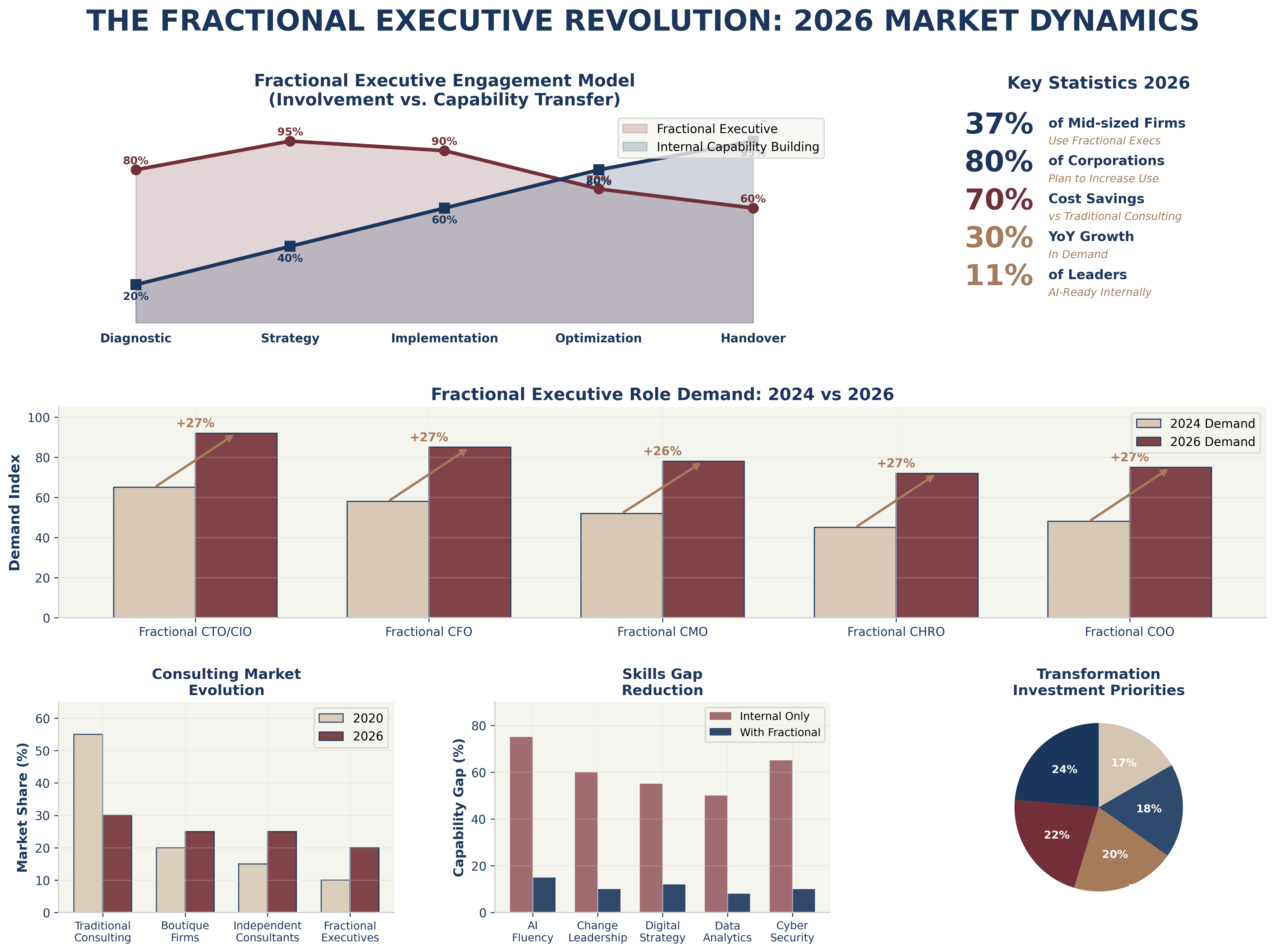
Despite massive investment in transformation, only 11% of talent leaders say their executives are well prepared to navigate AI transition. This capability gap represents both the greatest risk and the greatest opportunity for organizations in 2026.
Critical Leadership Skills for 2026:
2.2 The Skills-First Imperative
The half-life of skills continues to shrink, particularly in AI-related fields where knowledge becomes obsolete in months rather than years. Organizations are responding with skills-based hiring (70%+ of employers find it more effective than resume screening), continuous learning cultures, and internal mobility programs.
2.3 The "Human Skills" Premium
Paradoxically, as AI handles more technical tasks, human skills become more valuable:
Analytical Thinking: Ranked #1 core skill globally (72% of companies prioritizing)
Creativity: 73% of executives believe human creativity is more important than three years ago
Critical Thinking: Essential for validating AI-generated insights
Communication & Collaboration: Poor communication costs large organizations $62.4 million annually in lost productivity
3. The External Talent Revolution
3.1 The Shift Away from Traditional Models
The consulting industry is experiencing structural divergence. While the tech consulting market will surpass $400 billion globally by 2026, the way organizations access expertise is fundamentally changing.
Key Trends:
From Retainers to Results: Outcome-based pricing is replacing hourly billing, with fees tied to measurable business impact rather than time spent.
From Generalists to Specialists: There's a decisive shift away from generalist firms toward niche specialists with deep sector knowledge and regulatory expertise.
From Big Teams to Surgical Precision: Clients increasingly prefer "scalpels, not Swiss Army knives"—targeted expertise that delivers immediate impact without bureaucratic overhead.
3.2 The Rise of Fractional Executives
Fractional leadership has moved from startup curiosity to mainstream executive strategy. By mid-2026, 37% of mid-sized firms plan to employ fractional or interim executives, up from just 12% in 2020.
Why Fractional Executives Are Dominating Transformation:
Cost Efficiency: Access to C-suite expertise without full-time overhead
Speed to Impact: Deployment in days versus months for traditional executive search
Fresh Perspective: External viewpoint unencumbered by internal politics
Specialized Expertise: Deep experience in specific transformation types
Knowledge Transfer: Built-in capability building rather than dependency creation
Most In-Demand Fractional Roles for 2026:
3.3 The Independent Consultant Advantage
Beyond fractional executives, independent consultants are capturing significant market share from traditional firms:
Market Dynamics:
80% of large corporations plan to increase reliance on independent consultants
Cost savings of up to 70% compared to traditional firms while maintaining expertise levels
91% of businesses report higher satisfaction with independent consultants due to customized, hands-on approach
Why Independents Are Winning:
Agility: Rapid deployment without bureaucratic onboarding
Accountability: Personal reputation as sole currency creates results-focus
Transparency: Direct pricing models without hidden overhead (20% fees vs. 25-45% at traditional firms)
Specialization: Deep expertise in specific transformation niches
3.4 The Hybrid Talent Ecosystem
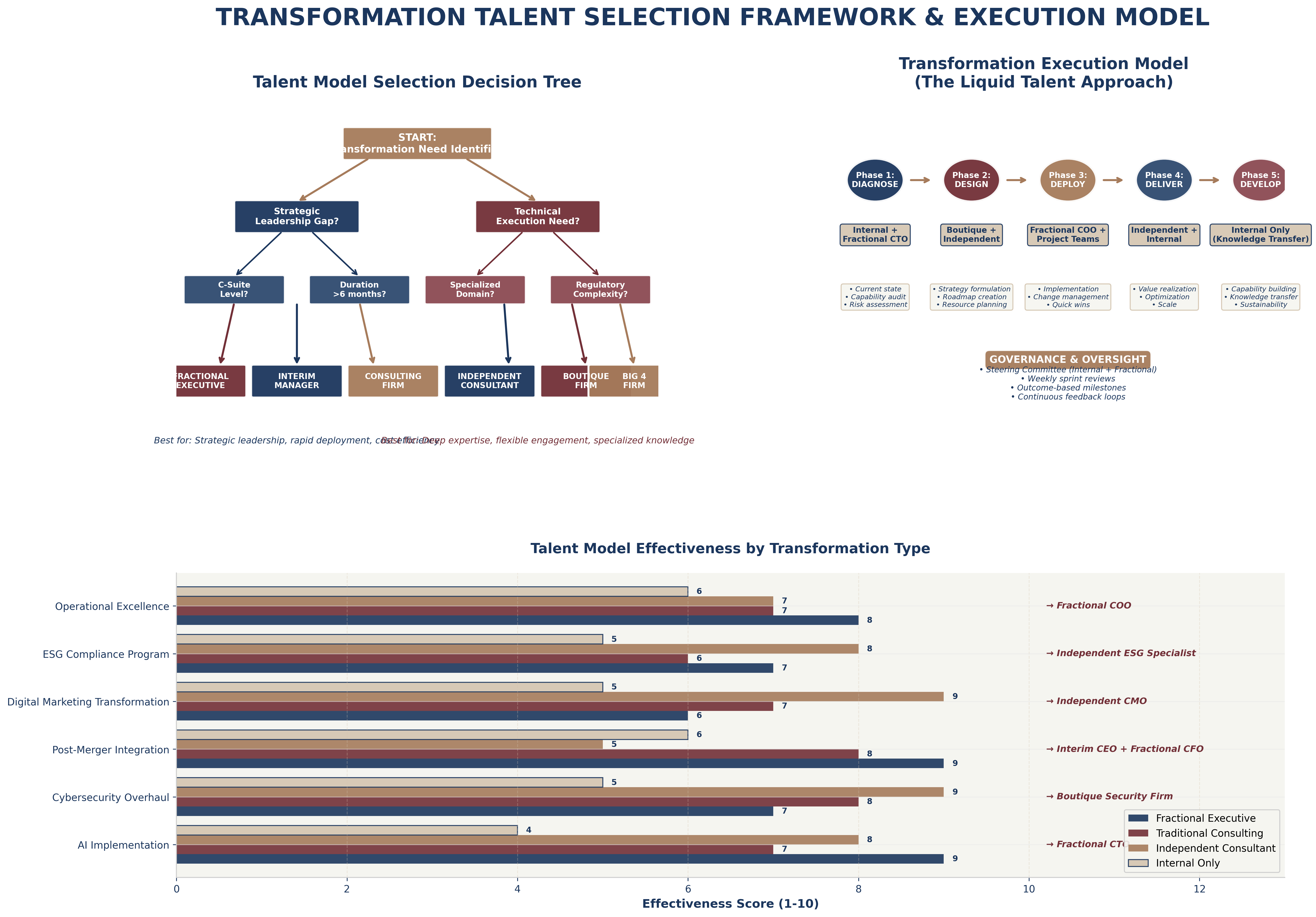
The most sophisticated organizations in 2026 are not choosing between internal, consulting firm, or independent talent—they're orchestrating all three:
The "Liquid Talent" Model:
Core Internal Team: Business context, culture carriers, continuity
Fractional Executives: Strategic leadership, transformation expertise, temporary capacity
Independent Specialists: Deep technical expertise, objective assessment, rapid execution
Boutique Firms: Regulatory complexity, multi-jurisdictional challenges, specialized methodologies
AI-Augmented Delivery: Automation of research, analysis, and content development
4. Strategic Implications for 2026
4.1 For Organizations Initiating Transformation
Audit Capability Gaps First: Before selecting talent, honestly assess internal readiness. Only 12% of businesses report having a strong pipeline of leaders ready for large-scale change.
Match Talent Model to Transformation Type
-
Prioritize Outcome-Based Contracts: Define success metrics upfront and tie compensation to results, not deliverables.
Build Internal Capability Concurrently: External talent should transfer knowledge, not create dependency. The best fractional executives make themselves obsolete by building internal competence.
4.2 For Consulting Firms
Develop Fractional Executive Practices: Create formal offerings that place senior partners in fractional roles rather than traditional project engagements.
Embrace Specialization: The era of the generalist strategy firm is ending. Deep expertise in specific transformation types commands premium pricing.
Integrate AI into Delivery: Use AI for research, synthesis, and content development to free consultants for high-value judgment work.
Adopt Transparent Pricing: Move toward outcome-based or value-driven models that align incentives with client success.
4.3 For Aspiring Fractional Executives
Develop Your "Pro Voice": In the fractional market, you are the brand. Build visibility through thought leadership and demonstrated expertise.
Specialize Ruthlessly: Generalist fractional executives struggle. Deep expertise in specific transformation types creates demand.
Master the "Micro-Leadership" Model: Success happens in rapid cycles—quick wins, immediate value demonstration, and continuous knowledge transfer.
Build Portfolio Diversification: Work across 2-4 organizations simultaneously to mitigate risk and maintain perspective.
5. Conclusion: The New Transformation Paradigm
2026 represents an inflection point in how organizations approach business transformation. The complexity of simultaneous technological, operational, and cultural change has outpaced the capacity of traditional talent models.
The winners will be organizations that:
Recognize that transformation is continuous, not episodic
Build "liquid" talent ecosystems combining internal, fractional, and independent expertise
Measure success by business outcomes, not project completion
Prioritize human skills (empathy, creativity, judgment) alongside technical capabilities
View external talent as strategic partners, not temporary labor
The rise of fractional executives and independent consultants is not a temporary market aberration. It is the structural future of executive leadership. As Gartner predicts, by 2026, over 60% of companies will rely on flexible leadership models as the default operating system for competitive advantage.
Organizations that embrace this shift will gain the agility to navigate uncertainty; those that cling to traditional employment models risk being outpaced by more adaptive competitors. In the transformation economy of 2026, talent flexibility expands beyond HR and becomes a core business capability.
Sources: This report synthesizes data from McKinsey, Gartner, Korn Ferry, Deloitte, Harvard Business School, and leading industry publications through February 2026.